
Restrictive haemoglobin thresholds and single unit blood transfusions toolkit
This page contains information for clinical and laboratory transfusion staff to support restrictive transfusion and a single unit approach to blood transfusion.
Patient blood management strategies are paramount to optimise patients' own red cells and avoid transfusion where possible.
However, where transfusion is unavoidable, restrictive haemoglobin thresholds and a single unit approach should be adopted.
Using restrictive haemoglobin (Hb) thresholds and targets for red blood cell transfusions, and transfusing one unit at a time, minimises inappropriate transfusion and reduces serious risks such as transfusion-related circulatory overload (TACO). It also improves patient outcomes, reduces hospital costs, and preserves blood stocks.
These guidelines apply to all patients apart from those with major bleeding and those requiring regular red cell transfusion or exchange transfusion.
In this section
Pages in the 'Appropriate use of blood components' section
Infographics
These infographics are designed for you to use alongside appropriate text in presentations and educational resources. Please acknowledge the NHS Blood and Transplant Patient Blood Management team as the author.
Don't give two without review
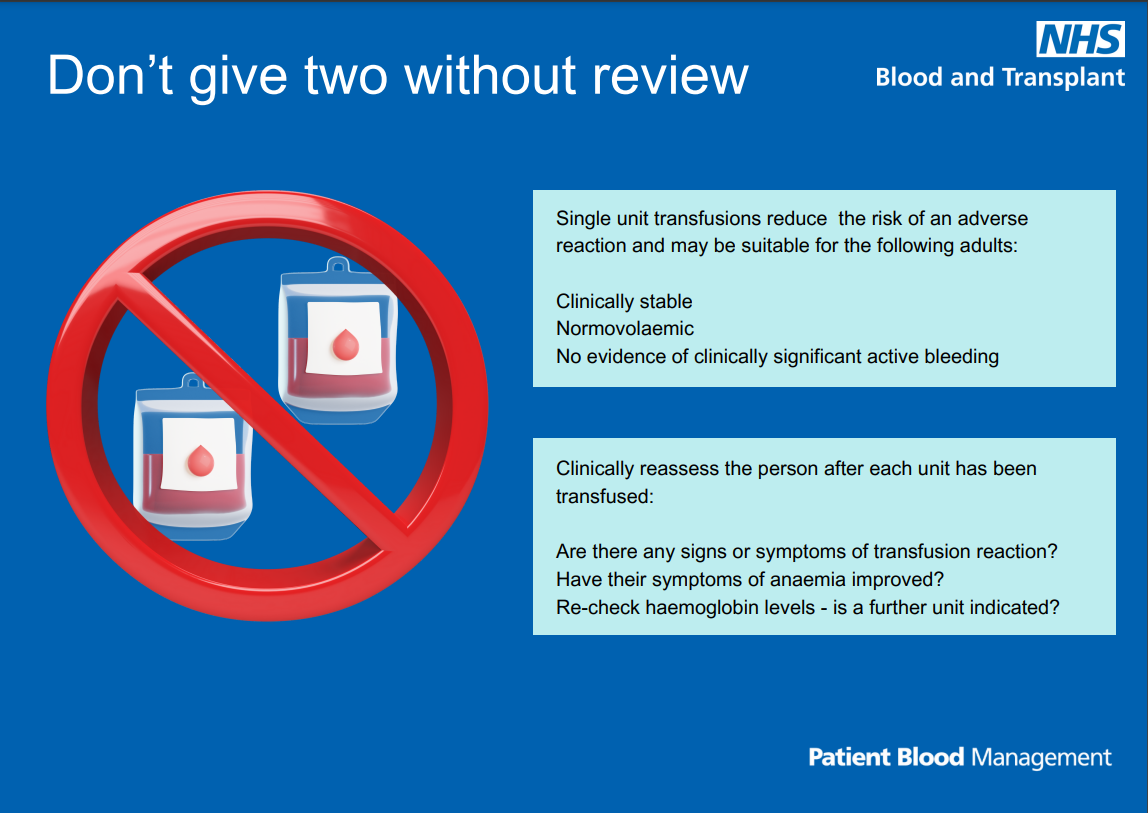
Text reads: "Single unit transfusions reduce the risk of an adverse reaction and may be suitable for the following adults:
- Clinically stable
- Normovolaemic
- No evidence of clinically significant active bleeding
Clinically reassess the person after each unit has been transfused:
- Are there any signs or symptoms of transfusion reaction?
- Have their symptoms of anaemia improved?
- Re-check haemoglobin levels - is a further unit indicated?"
Download the single unit transfusion infographic (PDF 1,041 KB)
Download the single unit transfusion infographic (PPTX 560KB)
Share your learning
Tell us about your single unit blood transfusions projects, highlighting your successes or where things didn't go so well, and we'll include them on this page.
Contact us at: pbm.team@nhsbt.nhs.uk
Page last reviewed: August 2026