
Epidemiology Unit: annual review
Our latest annual review is 'Safe Supplies 2025: 30 years of collaboration, surveillance and evidence' (PDF 3.3MB)
Download supplementary material below:
Please cite as: Safe Supplies 2025: 30 years of collaboration, surveillance and evidence. Annual Review from the NHS Blood and Transplant and UK Health Security Agency Epidemiology Unit. London September 2026. Available at https://hospital.blood.co.uk/diagnostic-services/microbiology-services/epidemiology/annual-review
Key message
This review highlights changes in donor selection, donation testing, and the collaborations and surveillance systems established over the past three decades. While these developments have significantly improved the safety of donors and recipients, and have increasingly incorporated behavioural science, we must also look to the future and the potential challenges posed by new and emerging infections.
Key highlights
Key highlights from this review include:
- Changes to blood donor selection criteria introduced in 2021 have not impacted on blood safety.
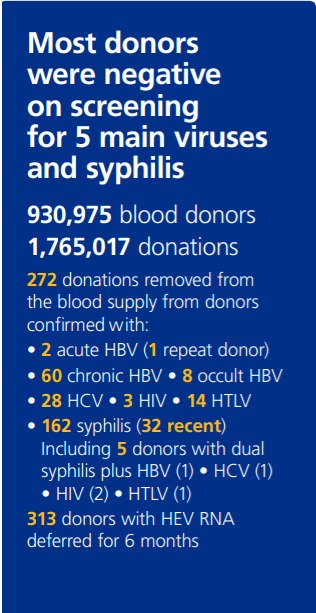
- Rates of acute, current and past infection remain low, with 272 blood donors withdrawn for HIV, HBV, HCV, HTLV and syphilis in 2025. Only one repeat donor showed evidence of recent HIV, HCV or HBV (seroconversion) in 2025.
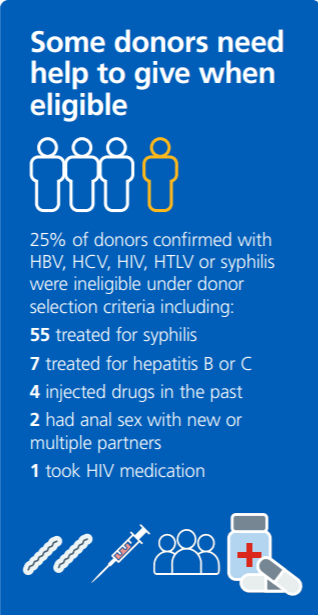
- Most donors disclose any potential risks of infection before donation, but at post-test discussion 25% of donors with markers of infections (excluding HEV) disclosed risks that made them ineligible, generally due to undeclared treated infection.
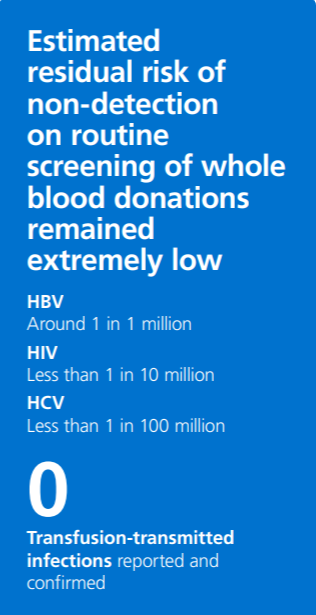
- The risk of blood donation screening failing to detect HBV, HCV or HIV due to a window period donation remained low, at approximately 1 per 1 million whole blood donations tested. Based on residual risk estimates, one window period donation would be expected every 0.5 years for HBV, every 8 years for HIV, and more than every 50 years for HCV.
- The Serious Hazards of Transfusion (SHOT) team are also celebrating their 30th anniversary, and in 2025, none of the 110 reported transfusion transmissions were confirmed.
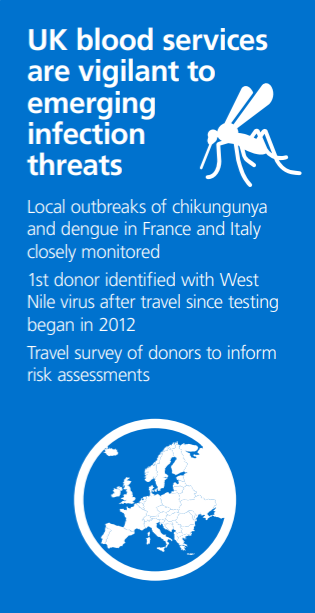
- We remain vigilant to emerging infection threats, including chikungunya and dengue outbreaks in mainland Europe. In 2025, selective West Nile virus (WNV) testing identified the first blood donor with WNV since testing began in 2012. Changing epidemiology of insect-borne infections is increasing selective screening and temporary donor deferrals.
- Close collaboration with UKHSA supports timely action on changes in international epidemiology, helping maintain the safety of blood, tissues and organs. Donor data also contribute valuable insights to public health surveillance.
- The unit also conducts surveillance of markers of infection in other donor groups on behalf of NHSBT, including deceased organ donors, cord blood donors, living surgical bone donors and deceased tissue donors. Evidence of current or past remained rare in 2025.
For more information about blood donation safety, including adverse events and reactions that have been reported, access annual reports on the Serious Hazards of Transfusion (SHOT) website
Data on tranfusion transmitted infections (TTI) in the UK is also on the TTI dashboard